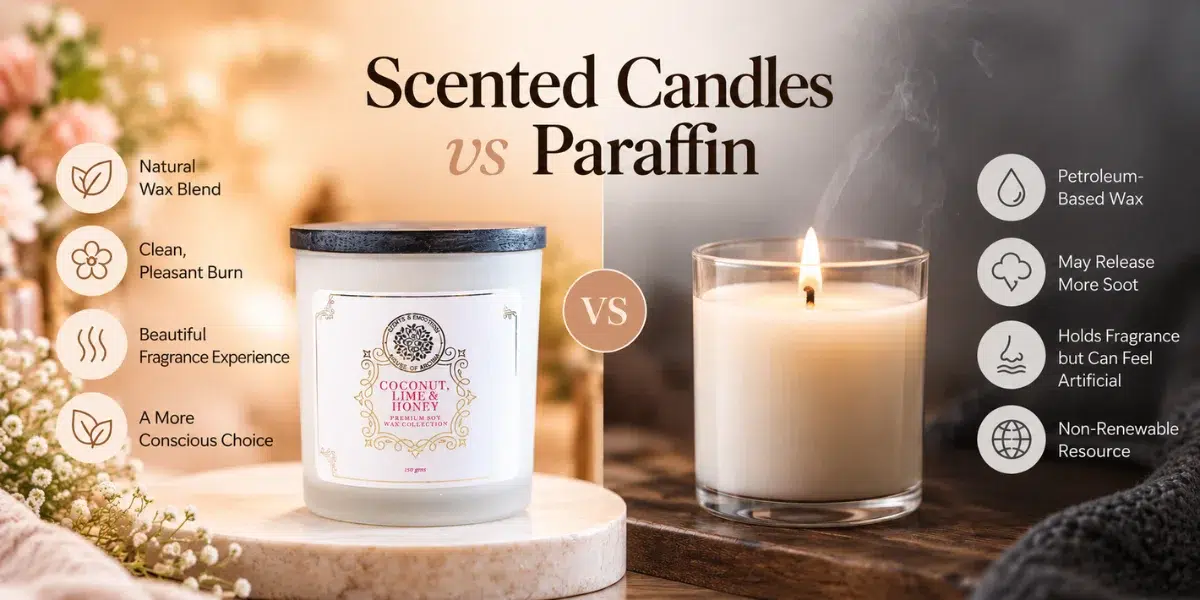
Natural Wax Scented Candles vs Paraffin is an important comparison for consumers who want to understand what they are bringing into their homes. Candles have become more than a source of light; they are used to create ambience, add fragrance to interiors, support relaxation and make everyday spaces feel warmer and more inviting. But with growing awareness about candle ingredients and indoor air quality, many people are asking whether natural wax is a better choice than paraffin.
The answer is not simply about choosing a candle labelled “natural.” The type of wax, fragrance, wick, additives, manufacturing quality and burning habits can all influence how a candle performs and what it releases into indoor air.
Natural Wax Scented Candles vs Paraffin also involves understanding the source of the wax. Natural waxes are generally made from plant- or animal-derived materials such as soy wax, coconut wax or beeswax, while paraffin wax is derived from petroleum refining. Natural waxes can offer advantages in terms of renewable sourcing and, depending on the formulation, burn characteristics. However, it is important not to assume that every natural wax candle is automatically healthier or more environmentally friendly.
Research has found that candle combustion can release particulate matter, volatile organic compounds and other combustion products. At the same time, studies indicate that emissions can vary considerably depending on the candle’s composition and how it burns.
When considering Natural Wax Scented Candles vs Paraffin, the better choice ultimately depends on what matters most to you, including the wax source, fragrance performance, environmental considerations, burning characteristics and overall candle quality. For consumers looking for plant-based or renewable waxes, natural wax scented candles can be an appealing alternative to paraffin.
What Are Natural Wax Scented Candles?
Natural wax scented candles are candles made using waxes that come from naturally occurring or renewable sources rather than petroleum-based paraffin. Common examples include soy wax, coconut wax and beeswax.
Soy wax is made from hydrogenated soybean oil, while beeswax is produced naturally by honeybees. Coconut wax is derived from coconut oil and is often blended with other waxes because of its softer physical characteristics.
The word “natural,” however, can mean different things depending on the product. A candle may contain natural wax but also include fragrance oils, dyes, additives or a blend of different waxes. Therefore, looking at the complete ingredient or product description is more useful than relying only on the word “natural” on the label.
Soy Wax
Soy wax is one of the most popular plant-based candle waxes. It is derived from soybean oil and is considered a renewable raw material. Soy wax is particularly popular for container candles because of its relatively soft texture and ability to hold fragrance.
Research comparing soy wax with paraffin has found differences in burning behaviour, including slower consumption and lower soot formation under the tested conditions.
Coconut Wax
Coconut wax is produced from coconut oil and is often used in premium candle formulations or blended with soy and other waxes. It is valued for its smooth appearance and ability to work well with fragrance formulations.
Beeswax
Beeswax is naturally produced by honeybees and has been used for candle making for centuries. It has a distinctive natural aroma and generally burns slowly. However, beeswax is not vegan and its availability and sourcing depend on beekeeping practices.
What Makes a Natural Wax Candle Different?
The key difference is where the wax comes from.
A plant-based wax such as soy or coconut originates from renewable biological resources, while paraffin comes from petroleum refining. That distinction can be important for consumers who want to reduce their reliance on fossil-derived materials.
However, natural wax does not automatically mean zero emissions. Every candle with a flame involves combustion, and combustion can produce gases and particulate matter. The wick, fragrance, flame stability and burn conditions all influence emissions.
What are natural wax scented candles made from?
Natural wax scented candles are commonly made from soy wax, coconut wax, beeswax or blends of these waxes, combined with fragrance and a wick.
Are soy candles natural wax candles?
Yes. Soy wax is a plant-derived wax made from soybean oil and is commonly used to make natural wax scented candles.
Are natural wax candles better than regular candles?
Natural wax candles can offer advantages such as renewable sourcing and different burn characteristics, but the overall quality of the candle also depends on its fragrance, wick and formulation.
Are all candles labelled “natural” 100% natural?
No. “Natural” can refer to the wax rather than every ingredient. Always check whether the candle is made from 100% natural wax or a wax blend.
Are natural wax scented candles suitable for everyday use?
They can be used regularly when burned correctly. Keep the wick trimmed, avoid drafts, follow the manufacturer’s burn instructions and maintain reasonable ventilation.
What Paraffin Wax Actually Is
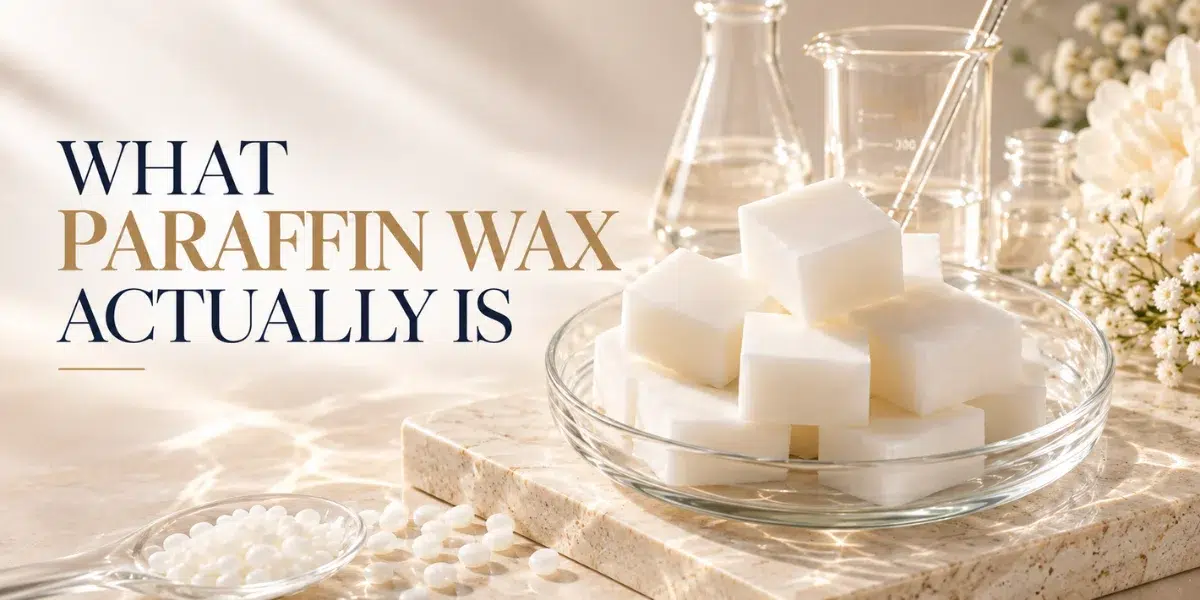
Paraffin is a refined petroleum-derived wax. It became widely used in candle manufacturing because it is inexpensive, versatile, stable and capable of producing strong fragrance performance.
Paraffin’s popularity does not mean that paraffin candles are inherently dangerous. Research into scented candle emissions has found that, under normal conditions of use, calculated indoor concentrations for many measured substances were generally below relevant guidance values, although some compounds and scenarios require consideration.
The more useful question is therefore not “Is paraffin toxic?” but rather how does a paraffin candle compare with other waxes in terms of source, performance, emissions and environmental considerations?
Why Is Paraffin So Common?
Paraffin has several practical advantages for candle manufacturers.
It can:
- Hold fragrance effectively
- Produce strong scent throw
- Accept colour easily
- Be used in different candle shapes
- Provide a consistent appearance
- Work well for decorative and sculptural candles
- Be produced at relatively low material cost
This is why paraffin remains widely used across the candle industry.
Does Paraffin Produce Soot?
Candle soot is primarily associated with incomplete combustion. It can occur when the flame becomes unstable or when a candle is burned under unsuitable conditions.
Research from the U.S. Environmental Protection Agency has shown that soot production can vary substantially between candles and that factors such as wick length, airflow and combustion conditions can influence emissions.
This is an important point because wax type is not the only factor responsible for soot.
An excessively long wick, strong draft, oversized wick or flickering flame can increase soot formation in a candle regardless of whether the wax is natural or paraffin.
Is Paraffin Automatically Unsafe?
No. That would be an oversimplification.
Studies have detected various gases and particles during candle combustion, including carbon monoxide, formaldehyde, benzene, particulate matter and other compounds. However, measured concentrations and potential exposure vary significantly according to the candle formulation and burning conditions.
The better approach is to look at overall candle quality and responsible use rather than treating every paraffin candle as hazardous.
What is paraffin wax made from?
Paraffin wax is a petroleum-derived wax obtained through refining processes.
Why is paraffin used in scented candles?
Paraffin is popular because it is versatile, cost-effective and can provide strong fragrance and colour performance.
Does paraffin wax produce soot?
Paraffin candles can produce soot, particularly when combustion is incomplete. Wick length, airflow and flame stability can strongly influence soot production.
Are paraffin candles toxic when burned?
It is inaccurate to say that all paraffin candles are inherently toxic. Candle combustion produces emissions, but the level varies by formulation and burning conditions.
Why do some people prefer natural wax over paraffin?
Many consumers prefer natural wax because it is plant- or animal-derived and can reduce reliance on petroleum-derived materials.
Differences Between Natural Wax and Paraffin Candles
When comparing natural wax scented candles and paraffin candles, it helps to look beyond the “natural versus synthetic” debate.
The two can differ in raw material source, burn behaviour, fragrance performance, environmental considerations and consumer preferences.
| Feature | Natural Wax Scented Candles | Paraffin Candles |
|---|---|---|
| Common waxes | Soy, coconut, beeswax | Paraffin |
| Primary source | Plant or animal-derived | Petroleum-derived |
| Renewable source | Often yes, depending on wax | No |
| Fragrance performance | Depends on formulation | Often strong |
| Burn characteristics | Vary by wax and formulation | Consistent and versatile |
| Soot | Depends on wick and burn conditions | Can produce soot, particularly with poor combustion |
| Environmental consideration | Renewable potential, but agriculture and processing matter | Reliant on fossil-derived raw material |
| Appearance | Often softer or more natural-looking | Smooth and highly versatile |
| Price | Often higher | Often more economical |
| Best choice | Consumers prioritising renewable/natural materials | Consumers prioritising cost, colour and fragrance performance |
1. Wax Source
The most obvious difference is the source of the wax.
Soy and coconut waxes originate from plant oils, while beeswax is produced by bees. Paraffin is derived from petroleum refining.
For consumers trying to reduce dependence on fossil-derived materials, this makes natural wax an attractive option.
2. Burn Performance
There is no universal rule that one wax always burns better.
A candle’s performance depends on:
- Wax formulation
- Wick size
- Wick material
- Fragrance concentration
- Candle diameter
- Vessel design
- Airflow
- Burn duration
A well-engineered paraffin candle can burn more evenly than a poorly wicked soy candle. Similarly, a natural wax candle can perform extremely well when its formulation and wick are properly matched.
3. Fragrance Throw
One of the reasons paraffin has remained popular is its ability to work effectively with fragrance formulations.
Natural waxes can also deliver excellent fragrance performance, but the result depends on the wax, fragrance composition, fragrance concentration, curing process and wick.
Therefore, saying that all paraffin candles smell stronger than natural candles or that all natural candles have better fragrance would be inaccurate.
4. Burn Time
Burn time varies significantly from one candle to another.
The weight of the wax alone does not determine how long a candle lasts. A candle with a larger wick may consume wax faster, while a smaller wick may produce a slower burn.
For shoppers, the most useful measure is the manufacturer’s stated burn time for the specific candle.
5. Overall Candle Quality
Perhaps the biggest lesson from comparing natural wax and paraffin candles is that wax is only one part of the equation.
A high-quality candle should have:
- A properly sized wick
- A stable flame
- A suitable fragrance formulation
- Good wax distribution
- Clear burning instructions
- Appropriate vessel design
- Quality raw materials
This is why simply choosing something labelled “natural” does not guarantee a superior candle.
Which is better, natural wax or paraffin candles?
Natural wax may be preferable if renewable or plant-derived materials are important to you. Paraffin can offer strong fragrance, colour and manufacturing performance. The better choice depends on your priorities.
Do natural wax candles burn longer than paraffin candles?
Some natural waxes can burn more slowly, but burn time depends on the wax, wick, candle size, fragrance and formulation.
Do natural wax candles smell as strong as paraffin candles?
They can. Fragrance performance depends on the complete candle formulation rather than wax alone.
Are natural wax candles more expensive?
They can be, because plant- or specialty waxes and smaller-batch production may cost more than paraffin.
Should I choose a 100% natural wax candle?
If renewable or plant-derived ingredients are important to you, a clearly labelled 100% natural wax candle can be a good option. Also consider the fragrance, wick, vessel and manufacturing quality.
Environmental Impact: The Bigger Picture
The environmental argument is one of the strongest reasons consumers consider natural wax scented candles instead of paraffin candles.
Paraffin wax candles is petroleum-derived, meaning its raw material is connected to the fossil-fuel supply chain. Natural waxes such as soy and coconut are derived from renewable biological sources, although that does not mean they have zero environmental impact.
Paraffin and Fossil Resources
Because paraffin originates from petroleum refining, it relies on a fossil resource that is not renewable on a human timescale.
This is an important distinction for consumers who want to reduce the fossil-derived materials used in everyday products.
However, paraffin is also a refined material and can be used efficiently in candle manufacturing. Environmental impact should therefore be evaluated across the entire product lifecycle rather than based only on whether the wax comes from petroleum.
Natural Wax and Renewable Resources
Plant-based waxes offer a different starting point.
Soy wax comes from soybean oil, while coconut wax comes from coconut oil. These are renewable agricultural resources.
But agriculture has its own environmental considerations.
The footprint of a natural wax can depend on:
- Farming practices
- Land use
- Water consumption
- Crop processing
- Transportation
- Refining
- Packaging
- Manufacturing
- Product lifespan
So calling a candle “natural” does not automatically make it environmentally perfect.
Don’t Forget the Packaging
When evaluating an eco-friendly scented candle, wax is only part of the environmental picture.
Consider the entire product:
Wax + fragrance + wick + vessel + packaging + transportation + end-of-life
A candle made from renewable wax but packaged in excessive single-use materials may have a larger overall footprint than consumers expect.
Reusable glass containers, recyclable packaging and responsible sourcing can therefore be important parts of a more sustainable candle strategy.
The More Sustainable Choice
If environmental considerations are your priority, natural waxes can provide a meaningful advantage because many are derived from renewable resources.
But the strongest approach is to look for a candle brand that is transparent about its materials, packaging and manufacturing rather than relying solely on the word “natural.”
Are natural wax candles better for the environment?
Natural waxes can have an advantage because many come from renewable resources, but their environmental impact also depends on farming, processing, transport and packaging.
Is paraffin wax environmentally friendly?
Paraffin is derived from petroleum, a fossil resource, so it is generally less attractive for consumers specifically seeking renewable candle materials.
Is soy wax more sustainable than paraffin?
Soy wax comes from a renewable plant source, which can make it a preferable option from a renewable-material perspective. However, agricultural production also has environmental impacts.
Are beeswax candles eco-friendly?
Beeswax is renewable and naturally produced, but its environmental credentials depend on responsible sourcing and beekeeping practices.
What makes a scented candle genuinely eco-friendly?
Look at the entire product: renewable wax, responsible fragrance sourcing, an appropriate wick, minimal or recyclable packaging, reusable containers and responsible manufacturing all matter.
The Health Impact: What You’re Actually Breathing
The health question is perhaps the most searched, and most misunderstood part of the natural wax vs paraffin candle debate.
You may have heard claims that natural candles are “non-toxic” while paraffin candles release dangerous chemicals. The reality is more nuanced.
Every candle with a flame is a combustion source.
When a candle burns, the wax and other materials involved in the flame can produce gases and particles. Research has detected carbon monoxide, nitrogen oxides, volatile organic compounds, particulate matter and other combustion products from candles.
The quantity varies according to the candle and how it is burned.
Does Natural Wax Mean Zero Emissions?
No.
A soy, coconut or beeswax candle still has a flame. Combustion can produce particulate matter and gaseous compounds even when the wax itself comes from a natural source.
This is why claims such as “100% toxin-free” or “zero emissions” should be treated cautiously.
What About Paraffin?
Paraffin combustion can also produce particulate matter and gaseous emissions. However, studies have found that emissions vary significantly depending on candle composition and combustion conditions. One comparative study examining different waxes and fragrances found that most calculated indoor concentrations were below relevant guidance values under the exposure scenarios tested, although certain compounds and cases warranted closer consideration.
This means the health discussion should focus on exposure, not fear.
Burning one candle occasionally in a reasonably ventilated room is very different from burning several heavily fragranced candles continuously in a small, poorly ventilated space.
Why Wick Maintenance Matters
A poorly maintained wick can create an unstable flame.
If the wick becomes too long, the flame may grow larger and produce more visible soot. Air movement can also disturb the flame.
Research has found that stressed or unstable burning can significantly increase soot and particle emissions.
This makes simple candle care surprisingly important.
How to Burn Scented Candles Responsibly
Whether you choose natural wax or paraffin, follow these basic practices:
Trim the wick: Keep the wick at the length recommended by the candle manufacturer.
Avoid strong drafts: Fans, open windows and air conditioners can disturb the flame.
Don’t burn for excessively long periods: Follow the manufacturer’s recommended burn time.
Ventilate appropriately: EPA guidance recommends ensuring proper ventilation when burning candles and incense indoors.
Watch the flame: If a candle is producing persistent black smoke or excessive soot, extinguish it and investigate the wick or burning conditions.
Don’t burn too many candles together: More flames mean more combustion products entering the indoor environment.
What About Fragrance?
The wax is not the only ingredient responsible for what you smell.
Fragrance formulations can contain many volatile compounds, and research has found that scented candles can release fragrance-related VOCs as well as combustion products.
Some people are also more sensitive to fragrances than others. The U.S. EPA notes that fragrances can cause adverse reactions in some sensitive individuals, although the science around specific fragrance-related health effects remains complex.
Therefore, if you are sensitive to strong fragrances, choosing a lighter fragrance profile and using candles in a well-ventilated environment may be more relevant than simply choosing soy over paraffin.
So, Are Natural Wax Scented Candles Healthier?
There is not enough evidence to make a blanket statement that every natural wax candle is healthier than every paraffin candle.
What can be said is that natural wax provides a renewable alternative to petroleum-derived paraffin, and some studies have found differences in soot and combustion behaviour between wax types.
But the complete formulation matters.
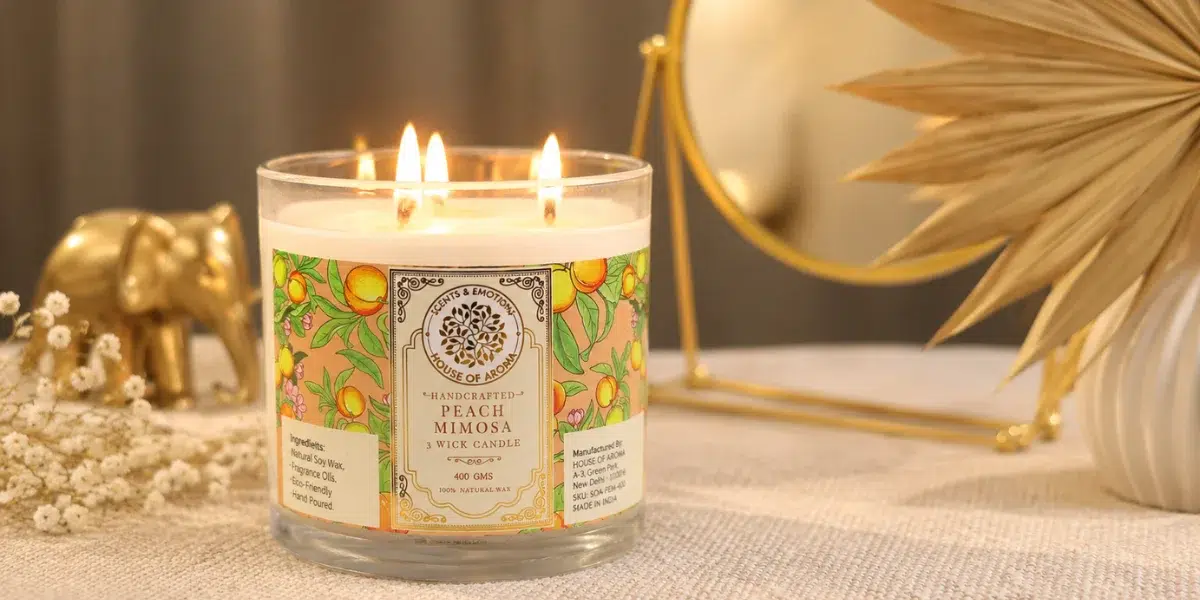
A well-made candle with a properly matched 3 wick candles, appropriate fragrance load and stable flame can be a better-performing product than a poorly formulated candle, regardless of its wax label.
Are natural wax scented candles safer to breathe?
Natural wax does not mean zero emissions. All burning candles produce combustion products, so ventilation, wick maintenance and responsible burning are important.
Do paraffin candles release harmful chemicals?
Candle combustion can release gases and particulate matter, and studies have detected compounds such as formaldehyde, benzene and other VOCs. Actual exposure depends on the candle and burning conditions.
Do soy candles produce soot?
Soy candles can produce soot if the wick is oversized, the flame is disturbed or combustion is incomplete. Natural wax does not guarantee a completely soot-free candle.
Are scented candles bad for indoor air quality?
Burning candles can contribute particulate matter and other emissions to indoor air. EPA recommends appropriate ventilation when burning candles indoors.
Can people be sensitive to scented candles?
Yes. Some people can experience adverse reactions to fragrances. If a fragrance causes discomfort, reduce exposure, improve ventilation or discontinue use.
So, Are Natural Wax Scented Candles Better Than Paraffin?
For many consumers, natural wax scented candles can be the better choice, particularly if renewable and plant-derived materials are important to them.
Natural waxes such as soy and coconut provide alternatives to petroleum-derived paraffin, while beeswax offers another naturally sourced option. Some research has also identified differences in soot and combustion behaviour between wax types.
But “natural” should not be treated as a guarantee of perfect indoor air quality or zero environmental impact.
The best candle is one that combines:
- High-quality wax
- A properly selected wick
- Carefully formulated fragrance
- Stable and controlled combustion
- Responsible sourcing
- Sensible packaging
- Clear burning instructions
For consumers, the simplest rule is this:
Choose the wax according to your priorities, but judge the candle as a complete product.
If renewable materials and a plant-based formulation matter to you, natural wax scented candles are an excellent option to consider. If strong fragrance, colour performance or cost is your priority, paraffin may still offer practical advantages.
Ultimately, the goal is not to create fear around one type of candle. It is to help you make an informed choice about what you bring into your home.
Final Takeaway
The debate over Natural Wax Scented Candles vs Paraffin does not have to be about declaring one material universally good and the other universally bad. Natural waxes offer an appealing alternative for people looking for renewable or plant-derived materials, while paraffin remains popular for its affordability, versatility and fragrance performance. At the same time, candle emissions depend on more than the wax alone, including the wick, fragrance, flame behaviour and ventilation.
When choosing a scented candle for your home, consider the complete candle rather than focusing on the wax alone. What is the wax? What is the fragrance? How is the candle made? How does it burn? And how should it be used responsibly?
At House of Aroma, scented candles are created to bring fragrance, warmth and ambience into everyday spaces. Whether you are choosing a candle for your living room, bedroom, workspace or as a thoughtful candle gift set, understanding the fragrance profile and candle characteristics can help you make a more informed choice.
Ultimately, the best scented candle is one that suits your fragrance preferences, complements your space and is used responsibly. With the right choice, a candle can do more than simply add fragrance, it can become part of the atmosphere and experience of your home.
Are natural wax scented candles better than paraffin candles?
Natural Wax Scented Candles vs Paraffin is largely a matter of personal priorities. Natural waxes such as soy and coconut wax are derived from renewable sources and can be appealing to consumers looking for plant-based alternatives. Paraffin, which is petroleum-derived, can offer advantages in fragrance performance, colour and cost. The quality of the wax, fragrance, wick and overall candle formulation also affects how a candle performs.
Which wax is best for scented candles?
Soy wax, coconut wax and beeswax are commonly used for scented candles, and each has different characteristics. Soy wax is popular for its plant-based origin, coconut wax is valued for its smooth finish and fragrance performance, while beeswax is naturally produced by bees. The best wax depends on the desired fragrance throw, burn time, texture, sustainability preferences and overall candle formulation.
Are natural wax scented candles healthier and environmentally friendly?
Natural wax does not automatically mean that a candle is completely emission-free or healthier. All candles with an open flame produce combustion by-products, while the environmental impact depends on the wax source, manufacturing, fragrance, packaging and transportation. Natural wax can be an appealing option for consumers who want to reduce their use of petroleum-derived materials.
How can I choose the right scented candle for my home?
When choosing a scented candle, consider the wax type, fragrance profile, candle size, room, burn time and wick. For example, softer floral or herbal fragrances can create a calming atmosphere, while woody, warm or rich fragrances can give living spaces a more luxurious feel. House of Aroma offers a range of scented candles in different fragrance profiles, making it easier to choose a scent based on your preferred mood and ambience.
How should I burn and care for natural wax scented candles?
Trim the wick according to the manufacturer’s recommendations before burning, place the candle on a stable heat-resistant surface and keep it away from drafts. Avoid burning a candle for longer than the recommended duration and never leave it unattended. If you notice excessive soot, smoke or an unusually large flame, extinguish the candle and check the wick and burning conditions. These practices apply whether you choose natural wax or paraffin candles, including House of Aroma scented candles.
Are House of Aroma scented candles good for gifting and everyday use?
House of Aroma scented candles can be used to add fragrance and ambience to everyday spaces and can also make thoughtful gifts for occasions such as birthdays, housewarmings, anniversaries and festive celebrations. When selecting a House of Aroma candle, consider the recipient’s preferred fragrance family, the space where it will be used and the type of ambience you want to create.