
Fragrance oils are widely used in scented candles, wax melts, reed diffusers, room sprays, soaps, and other fragranced products. But when working with fragrance oils, one technical property deserves particular attention: the flash point.
Understanding fragrance oil flash points helps candle makers, manufacturers, formulators, and hobbyists handle fragrance oils appropriately and make informed decisions during production. It can also help explain why certain fragrance oils behave differently when heated, blended, stored, or incorporated into finished products.
But what exactly is a fragrance oil flash point? Does a higher flash point mean an oil is safer? Can fragrance oil be added to hot wax? And does the flash point determine whether a fragrance oil can be used in candles?
Let’s explore these questions in detail.
What Is a Fragrance Oil Flash Point?
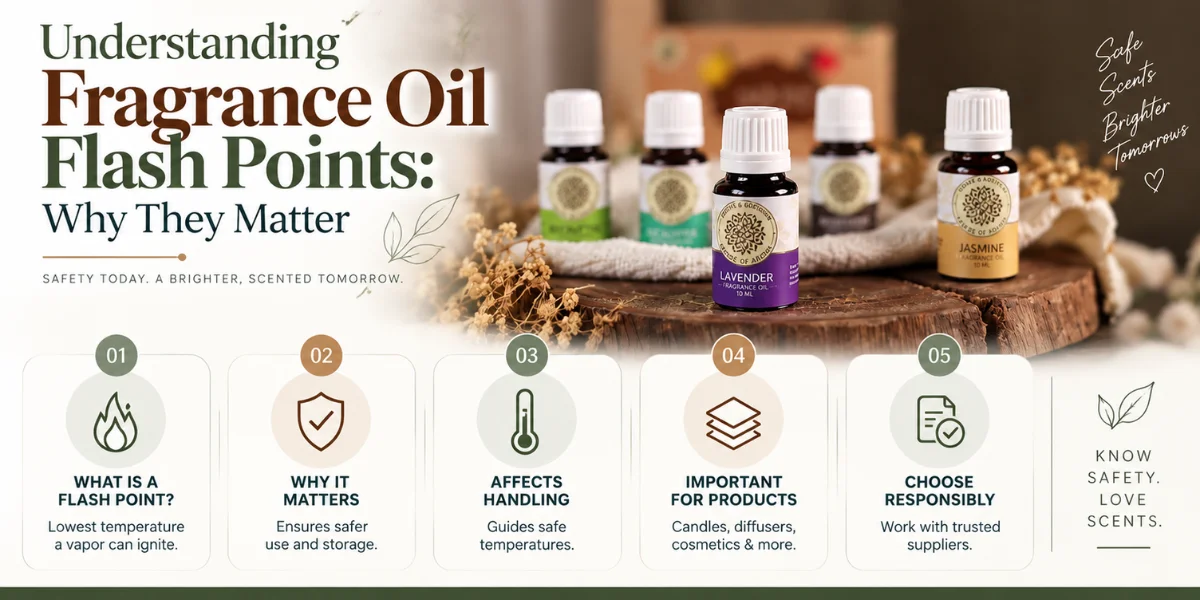
The flash point of a fragrance oil is the lowest temperature at which the oil can produce enough vapour to form an ignitable mixture with air when exposed to an ignition source under specified test conditions.
In simple terms, the flash point indicates a temperature at which the vapours generated by a fragrance oil may ignite when an ignition source is present.
It is important to understand that flash point is not the same as autoignition temperature or boiling point. These are different properties that describe different behaviours.
For fragrance manufacturers and candle makers, flash point is primarily a flammability and handling consideration. It should not be treated as a universal indication of how a fragrance will perform in a candle.
The flash point can vary significantly between fragrance oils because each formulation may contain different aromatic ingredients, solvents, carriers, and other components.
What does fragrance oil flash point mean?
It is the lowest temperature at which a fragrance oil can produce vapours capable of igniting when exposed to an ignition source under specified testing conditions.
Is fragrance oil flash point the same as boiling point?
No. Flash point identifies when vapours may ignite, while boiling point refers to the temperature at which a liquid changes to vapour throughout the liquid.
Why do fragrance oils have different flash points?
Different fragrance formulations contain different ingredients and concentrations, which influence their physical and flammability properties.
Does every fragrance oil have a flash point?
Flammable liquid classifications and applicable testing requirements depend on the formulation and jurisdiction. Suppliers should provide appropriate safety information for their products.
Where can I find the flash point of a fragrance oil?
The manufacturer’s Safety Data Sheet (SDS) is generally the best source for the reported flash point and related handling information.
Why Does Flash Point Matter for Fragrance Oils?

Flash point matters because fragrance oils are often used in environments where heat, electrical equipment, flames, and other ignition sources may be present.
For candle manufacturing, for example, fragrance oil may be introduced into heated wax. The manufacturer therefore needs to understand the properties of the fragrance oil and follow appropriate handling procedures.
However, the flash point should not be interpreted as a simple “maximum heating temperature.”
A fragrance oil with a flash point of 70°C does not automatically mean that the oil will catch fire at exactly 70°C. Flash point testing is conducted under defined conditions, and actual behaviour depends on factors such as vapour concentration, ventilation, ignition source, container geometry, and formulation.
Understanding this distinction is particularly important when designing production procedures.
Why is fragrance oil flash point important for candle making?
It provides useful information about the oil’s flammability characteristics and helps manufacturers establish appropriate handling and production procedures.
Does flash point determine whether a fragrance oil is safe?
No. Safety depends on the complete formulation, exposure conditions, handling procedures, storage, ventilation, and other factors.
Why should candle makers know the flash point of fragrance oil?
It helps them understand the material’s handling characteristics when working with heated wax and potential ignition sources.
Does a low flash point mean a fragrance oil cannot be used in candles?
Not necessarily. Candle suitability depends on the complete fragrance formulation, supplier guidance, testing, and intended application.
Is a higher flash point always better for fragrance oils?
No. Flash point is one technical property and does not by itself determine fragrance quality, candle performance, scent strength, or suitability.
How Is the Flash Point of Fragrance Oil Determined?
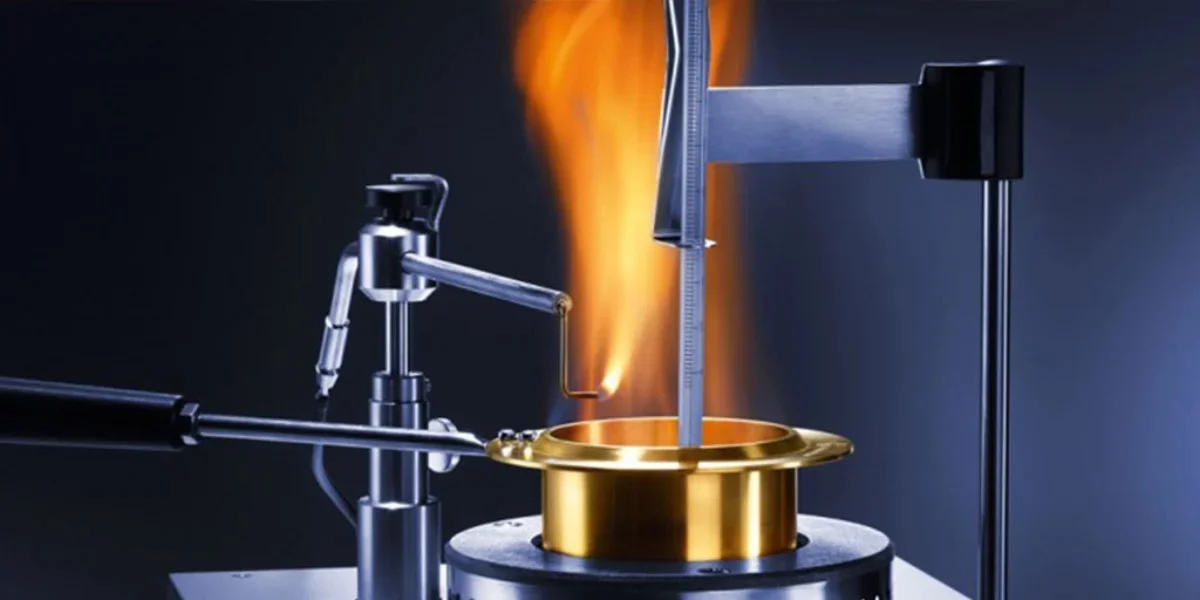
Flash point is determined through standardized testing methods designed to assess the temperature at which vapours from a liquid can ignite under specified conditions.
Different test methods can produce different reported values because the testing equipment and methodology can influence the result.
Two commonly discussed categories are:
Closed-Cup Testing
In closed-cup testing, the liquid is contained in a vessel where vapours accumulate above the liquid. An ignition source is introduced according to the test procedure.
Because vapours are retained within the test vessel, closed-cup measurements can differ from open-cup measurements.
Open-Cup Testing
In open-cup testing, the sample is exposed to the surrounding environment while being heated under a defined procedure. Vapours can disperse more freely.
This can result in a different flash-point value from a closed-cup test.
For this reason, you should use the flash point value and test information supplied by the fragrance manufacturer rather than trying to estimate the flash point yourself.
How is fragrance oil flash point measured?
It is measured using a standardized test method that determines the temperature at which vapours can ignite under specified conditions.
What is a closed-cup flash point?
It is a flash point measured using a closed container that allows vapours to accumulate above the liquid.
What is an open-cup flash point?
It is measured using an open test vessel where vapours can escape into the surrounding environment.
Can two flash point tests give different results?
Yes. Results can vary depending on the testing method, equipment, sample characteristics, and test conditions.
Should I calculate the flash point of my fragrance oil?
No. Use the manufacturer’s documented technical and safety information rather than estimating the flash point.
Fragrance Oil Flash Point and Candle Making

One of the most common questions from candle makers is whether fragrance oil flash point determines the temperature at which fragrance should be added to wax.
It does not work that simply.
A candle maker should consider the wax manufacturer’s recommended processing temperature, the fragrance supplier’s instructions, the specific fragrance formulation, and the requirements of the finished product.
Fragrance oils are typically blended into melted wax during a controlled manufacturing process. The mixing temperature needs to support proper incorporation of the fragrance while maintaining appropriate production and safety practices.
If fragrance oil is added at an unsuitable temperature, several issues may occur, including:
- Poor fragrance incorporation
- Inconsistent scent distribution
- Changes in fragrance performance
- Increased vapour generation
- Unnecessary exposure to heat
- Potential changes in the finished candle’s characteristics
It is therefore better to view flash point as one part of a broader safety and formulation assessment, rather than as the sole temperature limit for candle making.
Can I add fragrance oil to wax above its flash point?
Heating practices should follow the fragrance supplier’s SDS and technical guidance together with the wax manufacturer’s recommended processing conditions.
Does fragrance oil flash point tell me when to add fragrance to candle wax?
No. Flash point is not a universal fragrance-addition temperature. Follow supplier and wax-specific processing recommendations.
What happens if fragrance oil is overheated?
Excessive heating can increase vapour generation and may affect fragrance performance while creating unnecessary handling and fire risks.
Is a high-flash-point fragrance oil better for candles?
Not necessarily. Candle performance depends on many factors, including fragrance formulation, wax, wick, fragrance load, cure time, and testing.
What temperature should fragrance oil be added to candle wax?
There is no single temperature that applies to every candle. The appropriate temperature depends on the wax, fragrance formulation, supplier guidance, and manufacturing process.
Does a Higher Flash Point Mean Better Fragrance Oil?
A common misconception is that higher flash point automatically means better fragrance oil.
This is incorrect.
Flash point is primarily related to the conditions under which a liquid’s vapours can ignite. It does not directly measure:
- Fragrance quality
- Scent strength
- Scent throw
- Longevity
- Stability
- Candle performance
- Fragrance complexity
A fragrance oil with a relatively low flash point may perform exceptionally well in a properly formulated product. Similarly, a fragrance oil with a higher flash point is not automatically superior.
When choosing fragrance oils, manufacturers should consider the intended application, formulation compatibility, regulatory requirements, supplier documentation, and performance testing.
Is a higher fragrance oil flash point better?
Not necessarily. Flash point is a physical property and does not directly indicate fragrance quality.
Does flash point affect scent strength?
Flash point alone does not determine scent strength or fragrance throw.
Does a high flash point make a fragrance oil last longer?
No. Fragrance longevity depends on the formulation and application rather than flash point alone.
Should I choose fragrance oils based only on flash point?
No. Consider the complete technical data, intended application, performance, compatibility, and safety information.
What is more important than flash point when selecting fragrance oil?
The correct selection depends on the intended product, formulation requirements, supplier documentation, performance characteristics, and applicable safety standards.
Flash Point vs. Fragrance Oil Evaporation
Flash point is sometimes confused with the evaporation behaviour of fragrance oils.
Although related to the presence of vapours, these concepts are different.
Evaporation occurs when molecules escape from the surface of a liquid into the surrounding environment. It can occur below the flash point.
Flash point, on the other hand, refers to the temperature at which sufficient vapour is generated under specified test conditions to produce an ignitable mixture when an ignition source is applied.
This distinction matters because fragrance oils can release vapours even when they are nowhere near their reported flash point.
For manufacturers, this means ventilation and good handling practices remain important even when a fragrance oil is being used below its flash point.
Does fragrance oil evaporate below its flash point?
Yes. Evaporation can occur below the flash point.
Does a low flash point mean fragrance oil evaporates quickly?
Not necessarily. Flash point and evaporation rate are different physical properties.
Can fragrance oil vapours ignite below the flash point?
Flash point is defined under specific test conditions, so it should not be interpreted as a universal threshold for all real-world situations.
Why does fragrance oil smell even at room temperature?
Volatile molecules can enter the air through evaporation, allowing the fragrance to be detected by smell.
Is ventilation important when handling fragrance oil?
Yes. Appropriate ventilation and the handling precautions specified in the SDS are important when working with fragrance materials.
How to Read the Fragrance Oil SDS for Flash Point Information
The Safety Data Sheet (SDS) is one of the most useful documents for understanding fragrance oil handling requirements.
When reviewing an SDS, look for Section 9: Physical and Chemical Properties. Depending on the product and SDS format, this section may contain information such as:
- Physical state
- Colour
- Odour
- pH
- Melting/freezing point
- Initial boiling point
- Flash point
- Vapour pressure
- Relative density
- Solubility
- Auto-ignition temperature
You should also review Section 2, which provides hazard identification, and Section 7, which covers handling and storage.
Section 10 may provide information about stability and reactivity.
The SDS should be treated as a key safety reference, but users should also follow any additional technical instructions provided by the fragrance supplier.
Which SDS section contains flash point information?
Flash point is generally listed under Section 9, Physical and Chemical Properties.
What other SDS sections should fragrance users read?
Sections 2, 7, 8, 9, and 10 are particularly useful for understanding hazards, handling, exposure controls, physical properties, and reactivity.
Can I rely on a supplier’s product description instead of the SDS?
The SDS is the more appropriate document for detailed hazard and safety information.
Why might an SDS not show a flash point?
Depending on the formulation, classification, testing, and applicable SDS requirements, some properties may be reported as not applicable, not available, or otherwise documented.
Should the SDS be available in a fragrance manufacturing facility?
Businesses should maintain and provide applicable safety documentation according to local occupational and chemical-safety requirements.
Safe Handling and Storage of Fragrance Oils
Understanding flash point is only one part of responsible fragrance oil handling.
Good practices include storing fragrance oils in appropriate, properly labelled containers and keeping them away from unnecessary heat and ignition sources.
Manufacturers should also:
- Follow the supplier’s SDS
- Maintain suitable ventilation
- Avoid unnecessary exposure to heat
- Keep containers properly closed
- Use appropriate personal protective equipment when required
- Prevent spills and contamination
- Follow workplace chemical-handling procedures
- Store products according to supplier recommendations
- Keep fragrance oils away from incompatible materials where applicable
For commercial candle and fragrance manufacturing, employees should receive appropriate training on chemical handling and emergency procedures.
How should fragrance oils be stored safely?
Store them in suitable, labelled containers under the conditions specified by the supplier and SDS, away from unnecessary heat and ignition sources.
Should fragrance oil containers be kept closed?
Yes. Containers should generally remain properly closed when the material is not being used.
Do fragrance oils need ventilation during storage?
Storage requirements depend on the product and workplace conditions. Follow the SDS and applicable safety requirements.
Can fragrance oils be stored near open flames?
No. Fragrance oils should be kept away from ignition sources in accordance with their safety documentation.
What PPE should be used when handling fragrance oil?
PPE depends on the specific formulation and exposure risk. Consult the SDS, particularly its exposure-control and PPE recommendations.
Common Mistakes When Interpreting Fragrance Oil Flash Points
Even experienced scented candle makers can misunderstand flash point information.
Mistake 1: Treating Flash Point as a Maximum Heating Temperature
A flash point is not automatically the maximum temperature to which a fragrance oil can ever be exposed.
Mistake 2: Assuming Higher Is Always Safer
A higher flash point does not eliminate the need for appropriate handling, ventilation, storage, and fire-safety procedures.
Mistake 3: Using Flash Point to Judge Fragrance Quality
Flash point does not tell you whether a fragrance smells better, performs better, or provides stronger scent throw.
Mistake 4: Ignoring the SDS
Online product listings may provide limited information. The SDS and technical documentation should take priority for safety-related decisions.
Mistake 5: Assuming All Fragrance Oils Behave the Same
Every fragrance formulation can have different physical and chemical properties.
Is flash point the maximum temperature for fragrance oil?
No. It is a specific flammability property determined under defined testing conditions.
Does a high flash point mean the oil cannot burn?
No. Flash point does not mean that a liquid is non-combustible.
Can I compare two fragrance oils only by flash point?
No. A meaningful comparison requires considering their complete technical and safety properties.
Is flash point a measure of candle scent throw?
No. Scent throw and flash point describe completely different characteristics.
What is the biggest mistake when using fragrance oil flash point data?
Treating the flash point as the only factor governing processing, storage, or candle-making safety.
Why Fragrance Oil Flash Point Matters for Manufacturers
For fragrance oil manufacturers, candle companies, soap makers, home-fragrance brands, and other formulators, understanding flash point helps support responsible product handling and production planning.
However, professional formulation requires looking beyond one number.
A manufacturer should consider:
- Fragrance formulation
- Intended application
- Flash point and other physical properties
- SDS information
- Wax or base compatibility
- Processing conditions
- Storage requirements
- Workplace safety
- Applicable regulations
- Finished-product testing
For businesses sourcing fragrance oils in India or internationally, working with a reliable fragrance supplier that provides appropriate technical and safety documentation can make product development much easier.
A professional supplier should be able to provide relevant documentation and guidance for the intended application.
Why should fragrance manufacturers provide flash point information?
It helps professional users understand the physical and flammability characteristics of the fragrance material and establish appropriate handling procedures.
What should candle manufacturers ask their fragrance supplier for?
They should request relevant technical specifications, SDS documentation, application guidance, and information needed for their intended product.
Does flash point affect industrial fragrance processing?
It can be relevant to heat management, storage, handling, and workplace safety procedures.
Should fragrance suppliers provide SDS documentation?
Appropriate safety documentation should be provided and maintained according to applicable requirements.
How can manufacturers choose the right fragrance oil?
They should evaluate fragrance performance, application compatibility, technical specifications, safety documentation, regulatory requirements, and supplier support.
Final Takeaway: Understanding Fragrance Oil Flash Points
The fragrance oil flash point is an important technical property that helps users understand the flammability characteristics of a fragrance material under defined test conditions.
But it should never be viewed in isolation.
A flash point does not tell you whether a fragrance oil is “good,” how strong its scent will be, or exactly what temperature you should use when making candles. Instead, it should be considered alongside the SDS, supplier recommendations, processing conditions, storage requirements, formulation compatibility, and applicable safety standards.
Whether you are making candles at home or developing fragrances for commercial production, understanding flash point can help you handle fragrance oils more responsibly and make better-informed formulation decisions.
What is the flash point of fragrance oil?
It is the lowest temperature at which vapours from the fragrance oil can ignite under specified test conditions when exposed to an ignition source.
Does fragrance oil flash point determine candle-making temperature?
No. Candle-making temperatures should be based on the wax manufacturer’s instructions, fragrance supplier guidance, formulation requirements, and appropriate safety procedures.
Is a higher flash point better?
Not necessarily. Flash point is a physical property and does not directly indicate fragrance quality or candle performance.
Where can I find the flash point of my fragrance oil?
Check the supplier’s SDS, typically under Section 9, Physical and Chemical Properties.
Can fragrance oil be flammable below its flash point?
Flash point is determined under specific test conditions, so it should not be treated as a universal boundary for every real-world ignition scenario.
Does flash point affect fragrance strength?
Not directly. Fragrance strength depends on formulation, concentration, application, and other factors.
Why do different fragrance oils have different flash points?
Their formulations contain different combinations and concentrations of aromatic and carrier materials.
Can fragrance oil evaporate below its flash point?
Yes. Evaporation can occur at temperatures below the flash point.
Should fragrance oils be kept away from flames?
Yes. Follow the product SDS and keep fragrance materials away from unnecessary ignition sources.
Is flash point the same as autoignition temperature?
No. Flash point and autoignition temperature describe different ignition behaviours and should not be used interchangeably.